

2026.05.16 - 14:00
1946: Walking the Line Between Life and Death — Disaster Sketches by Situ Qiao and Fu Luofei
- Time2026.5.16 2:00 PM
- Venue2F, Taikang Art Museum, Timber Shade - Space for All
- SpeakerChen Zhiyun
- ModeratorXu Chongbao
- Tags:
From 19 April to 5 July 2026, Taikang Art Museum presents A Changed World: Fu Luofei’s Realist Painting and Chinese Wartime Art, the most comprehensive retrospective of Fu Luofei (1897–1971) to date. The exhibition brings together more than 400 works, including 29 masterpieces from the Taikang Collection, alongside over one hundred historical documents. Many previously unpublished manuscripts and archival materials are presented to the public for the first time, offering invaluable resources for future scholarship. Admission to the exhibition is free, and an extensive public programme of lectures, workshops, and symposia brings together leading professionals from the fields of art, academia, and museums in China and abroad.
New Year’s Day in 1946 marked China’s first New Year following victory in the War of Resistance Against Japanese Aggression. Yet the nation, still reeling from years of devastating conflict, soon found itself confronted by another humanitarian catastrophe as widespread famine spread across much of the country.
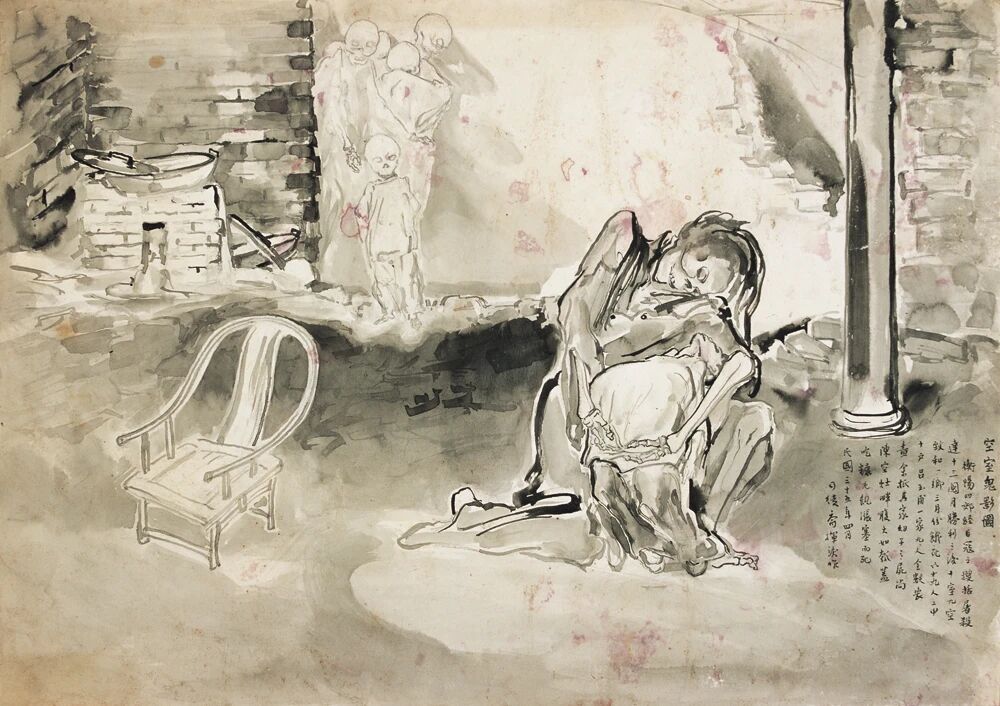
Invited by Jiang Tingfu, Director-General of the Executive Yuan Relief and Rehabilitation Administration, the artist Situ Qiao (1902–1958) travelled through the five provinces of Guangdong, Guangxi, Hunan, Hubei, and Henan, where conditions were at their most severe. There he documented the aftermath of the disaster through a series of famine paintings, which were subsequently exhibited in Nanjing, Shanghai, and the United States.
Situ Qiao described this journey of more than 5,000 li as “walking with death.” Along the way, he witnessed countless famine victims dying before his eyes. In tears, he produced more than eighty paintings. His wife, Feng Yimei (1908–1976), transformed the same journey into an 80,000-word documentary account entitled After the Catastrophe.
Together, one through painting and the other through writing, the couple documented what they witnessed in the disaster-stricken regions, leaving behind an irreplaceable record of one of the darkest chapters in modern Chinese history.
Fu Luofei (1897–1971) was equally moved by the humanitarian crisis. Travelling through Hunan, Guangxi, and Guangdong, he recorded the suffering of famine victims in a series of sketches and later presented these works in exhibitions titled The Starving People in Guangzhou and Hong Kong.
Focusing on Situ Qiao and Feng Yimei’s 1946 field investigation, this lecture revisits a chapter of history that should not be forgotten, while offering new perspectives on Fu Luofei’s disaster sketches created during the same period.