

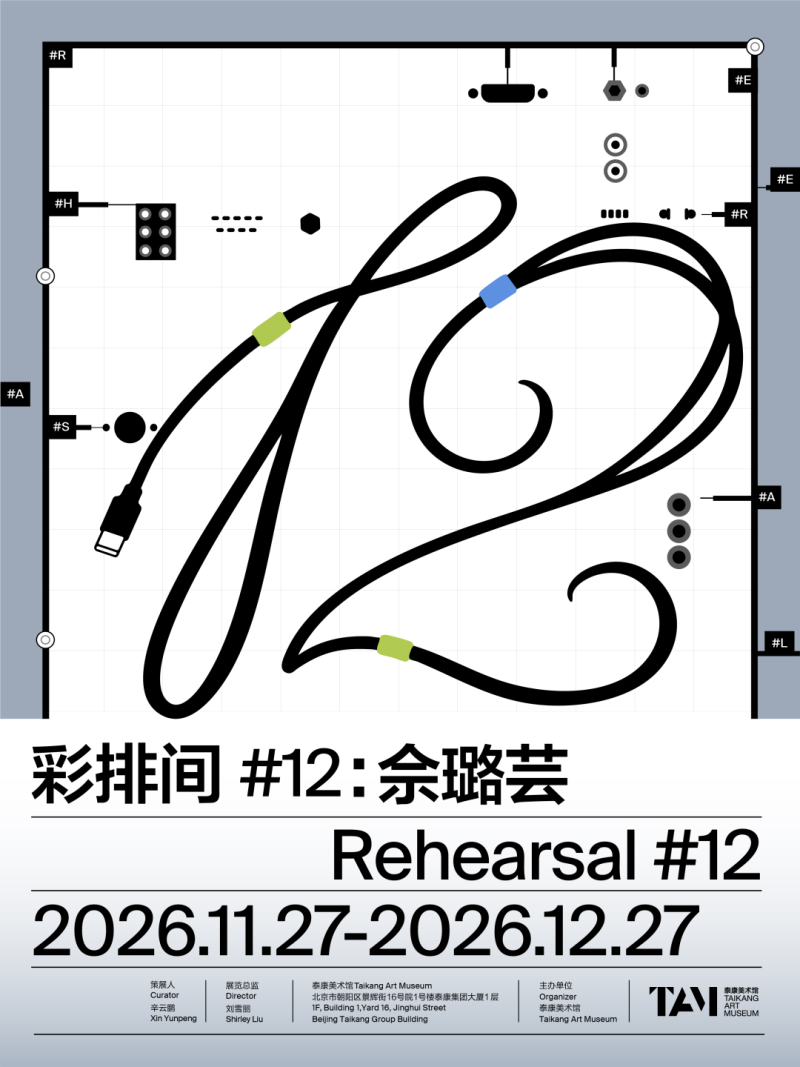
2026.11.27 - 2026.12.27
REHEARSAL #12 She Luyun
- OrganizerTaikang Art Museum
- Venue1F, Building 1, Yard 16, Jinghui StreetBeijing Taikang Group Building
- CuratorXin Yunpeng
- DirectorShirley Liu
- ArtistsShe Luyun
Around 2010, Taikang Space, the predecessor of Taikang Art Museum, launched the “51m²” project to support a group of young local artists in developing new artistic practices. The “Pavilion of Sunlight” exhibition series that followed further extended this curatorial direction, bringing together artists and curators from diverse educational backgrounds and fostering close connections across disciplines through contemporary art. As a non-profit art institution with a distinctive programmatic approach in China, Taikang Space has long accompanied the growth of artists and contributed to the ongoing development of Chinese contemporary art.
While continuing its research and collection work in modern and contemporary Chinese art, image history, and new media art, Taikang Art Museum launched a new program, “Rehearsal,” in 2025. Conceived as a platform for exploratory solo exhibitions, the program builds on the legacy of the “51m²” project and the “Pavilion of Sunlight” series. Situated in the museum’s CBD public space, “Rehearsal ” aims to support the presentation and study of individual artistic practices, and to continue fostering the development of contemporary art in China alongside artists and their evolving work.
In The Greatest Thunderbolt Interface (2026), the video unfolds as a fictional tech-sharing conference that gradually evolves into a collective debate on speed, capital, and the future. A mere port for connecting devices is endowed with expectations far beyond its actual function; people speak and argue around it, as if discussing a shared faith.Through She Luyun’s orchestration, the language of technology reveals a familiar enthusiasm: faster transmission, broader connectivity, as if this alone could explain why life requires constant upgrading. The word “greatest” in the title carries an exaggerated, comedic tone, making a specific question tangible—how much of our imagination of the future has already been replaced by the next generation of products?
She Luyun grew up in an electronics factory environment. To her, an electronic product has a long and concrete origin; the desirable convenience, precision, and speed coexist in the very same object alongside the repetitive labor of the workshop. Her interest in the electronics industry carries this contradictory feeling: attracted by its achievements, yet disenchanted by its production process.The film transfers this relationship into the internal structure of language. The presenter advocates for the Thunderbolt interface, seeking a mutually acceptable explanation. Technical terminology appears to provide a basis for communication, yet constantly plunges it into new disagreements. The interface of a digital product implicates brands, standards, interests, and the stances of users. She Luyun stirs these voices together, exposing the awkwardness and absurdity within serious discourse.
People are so eager to talk about the future that they have no time to clarify where exactly they hope to arrive. She Luyun appears at the end of the film, singing loudly: “Shanzhai [copycat] heals all humanity… only piracy grants us that future.” This “manifesto” carries both a joke and a genuine desire. The singing pulls the discussion back to an authentic demand while colliding with the endless conditions appended by professional discourse. Why must the path to convenience always be arranged by these tech oligarchs? Her enthusiasm for technology transforms here into an impulse that overflows technology itself—an impulse concerning the real social disparities.This impulse takes the shape of occupying space in the “swing ride” installation. Smartphones, cameras, power banks, game controllers, and electric fans are suspended by USB Type-C cables, rotating around a single center. Consumer electronics of different brands, purposes, and prices participate together in an amusement ride. The connections originally hidden in daily operations are directly exhibited; the cables simultaneously serve the functions of connection and suspension. Those portable devices that promised to bring more freedom are now, like passengers, arranged on predetermined tracks.
The installation has an immediate visual appeal. The metal canopy, hanging objects, and rotating structure evoke the excitement and brief weightlessness of an amusement park. She Luyun attempts to present this seduction while ruthlessly tossing the “infatuation with technology” into mid-air. The work’s lengthy title mixes technical names, parentheses, playtime, and the repeated “90 seconds,” finally landing on “spinning.” Language strives forward while branching out and looping back to its origin, where pleasure and futility occur simultaneously.Port (2025), on the other hand, makes connection heavy. She Luyun collected and recast scrap tin that workers knocked off soldering irons while repairing circuit boards, forging it into a metal plate riddled with 153 jacks (terminals). Densely arranged on the same surface, the differently shaped jacks resemble a tactile catalog of interfaces. Originally distributed in tiny amounts inside electronics to permanently fix and conduct components, the tin is now gathered into an object with thickness and weight, compelling the gaze to linger on places that are usually just rapidly plugged in and pulled out.
The word “Port” simultaneously implies a terminal, a harbor, and an entrance. The holes provide the possibility of access while dictating what can enter; the familiar act of connecting always presupposes a match in shape and standard. This sculpture indiscriminately connects a multitude of ports, resulting in the absurd failure of a short circuit, while leaving behind only the distinct standardized contours of each.Accompanying artist She Luyun, Taikang Art Museum’s Rehearsal project reaches its 12th edition. For artists of She Luyun’s generation, technological change has penetrated deep into everyday experience, becoming a crucial way to understand reality. Her upbringing, closely tied to the electronics factory, gives her a “back-to-back” dependence on technology, while also engaging in a “face-to-face” wrestling match with it. She is like a child who loves to break things: knowing how machines work but unable to resist altering them; understanding certain rules but always wanting to see what happens when they are crossed. She brings those fervent rhetorics about technology back to life as it is happening. In those familiar places that appear to be already properly connected, strange gaps worth questioning re-emerge.