

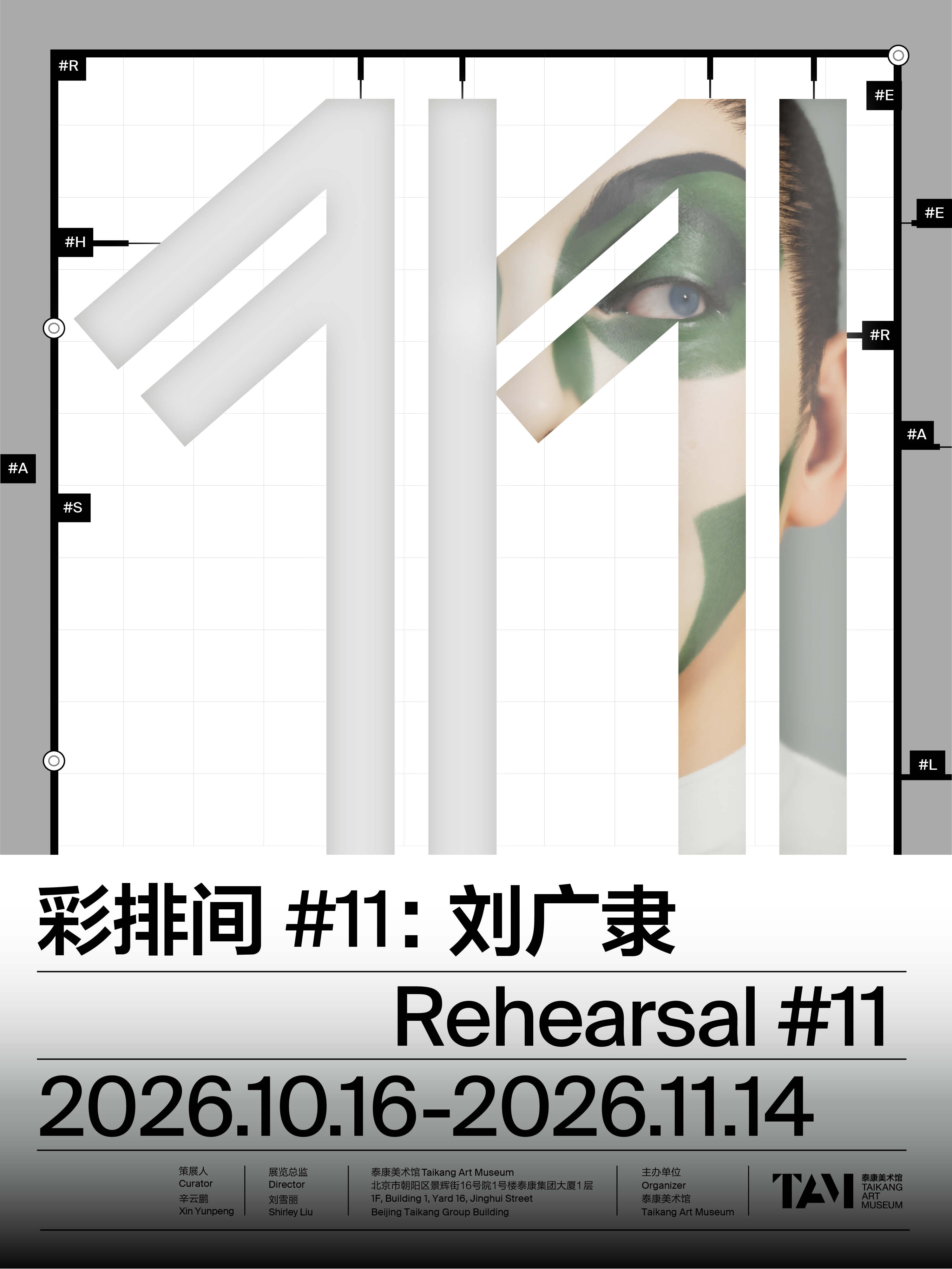
2026.10.16 - 2026.11.14
Rehearsal #11 Liu Guangli Rehearsal
- OrganizerTaikang Art Museum
- Venue1F, Building 1, Yard 16, Jinghui StreetBeijing Taikang Group Building
- CuratorXin Yunpeng
- DirectorShirley Liu
- ArtistsGuo Cheng, Hu Didi
In the video work Antimony Capital News (2019), Liu Guangli returns to his hometown of Lengshuijiang and intervenes in the shooting of a documentary. He reassembles archival footage from the local television station together with footage from the documentary shooting site: what the camera records, who is allowed to stand before it, which experiences are considered suitable for inclusion in the history of a city, and which details are discarded as the narrative takes shape — these decisions themselves constitute the initial path toward understanding Liu Guangli’s work.
The visual material presented in Antimony Capital News originates from clearly identifiable sources: it was filmed by particular people in particular spaces and within particular historical contexts, bearing both the natural characteristics of the medium itself and the deliberate gaps left by human and technical factors. Liu Guangli does not add a unifying explanation to these materials that would encompass the whole. Through editing, he allows the already completed narrative to once again reveal the traces of its production, thereby constructing a genuine contemporary moment within this film.
In his subsequent works, Liu Guangli’s working method underwent a distinct shift, pushing the question toward another level: images can emerge without a photographic scene; details can be attributed to a past that no one directly experienced; and actions that have not yet taken place can be organized and arranged in advance. The “narrator” thus becomes a constantly shifting position within Liu Guangli’s work. It may be the person recounting an experience in front of the camera, or the editor determining the sequence of materials; it may be embodied through familiar cinematic language, and it may also remain concealed within a system that allows viewers to operate it, while predetermining the modes of operation.
The new work Rehearsal brings these questions together within a double “reenactment” following a single “interview.” More than twenty actors undergo a casting process and respond to questions concerning vision, memory, and the “unseen.” Their voices, pauses, and facial movements are recorded and become the “raw material.” Yet viewers in the exhibition space cannot directly see them; they can only encounter either the reenactment through virtual faces driven by facial data, or a live actor reenacting the original interview scene.
Facial data can preserve movements, and actors can reproduce speech, yet neither can make the inner experience of the original speaker directly verifiable. The spatial arrangement of the work materializes this divide within the act of viewing. The two reenactments are strictly synchronized in time yet situated in separate spaces. As viewers move from one to the other, comparison can only be carried out through memory. A display screen outside the space continuously shows the discrepancies identified by the system, while the viewer is left only with the immediate, embodied experience of a single moment within that space.
It is here that Liu Guangli’s critique of technology finds its concrete focal point. Image technology enables experience to be preserved and transmitted, giving it an alternative form through which it can be interpreted; yet as this capacity for interpretation expands, the embodied limitations inherent in the technology itself risk being obscured. The reading and analysis of data has not genuinely dealt with the bodily experience that the act of imitation aims to exchange. In the generation of virtual images, the closer one approaches the original data, the further one is from the true meaning of imitation itself; conversely, the more accurately the live actor reenacts a role, the more one becomes aware that within an expression, certain elements can be transferred, while others remain inextricably tied to the specific context in which they arise.
From Antimony Capital News, in which the artist physically intervenes in the site of image production, to Rehearsal, which incorporates a set of “viewing” data handed over to machines for reading and for public comparison, Liu Guangli continues to interrogate a series of mechanisms surrounding the generation of images: how images are produced, by whom they are produced and controlled, and how they circulate and disseminate. In his own way, Liu Guangli enables us to uncover the flaws within seemingly credible images.
Rehearsal not only echoes the name of the Rehearsal project in its title, but its work structure also folds back onto the very framework that makes it possible, so that the framework itself is no longer merely an assumed external condition. Within Rehearsal, viewers cannot step outside the two reenactments to arrive at a complete and definitive answer; “revelation” always requires the participation of human experience, memory, and the “noise” within the viewer’s inner being. Similarly, the Rehearsal project itself cannot stand outside the artists’ explorations and predetermine what kinds of practices deserve to be fully seen, or where those practices should ultimately arrive. It is precisely here that “rehearsal” ceases to refer solely to the preparation before an official performance and instead becomes a condition that allows practice to remain in a state of continual recalibration, even after it has been presented.